The Climate Crisis
A point of view about the crisis we face, from Terry Smith
What is this Climate Crisis? Is it just global warming with another name? No, it is not just a crisis of the climate.
It is a crisis of the seas leading to a huge increase in suffocating, oxygen dead zones and rising sea levels.
It is a crisis of the air with thousands of people dying each year through air pollution.
It is a crisis of the ground with global heating creating huge new deserts that are made much more likely by the way we have exploited and continue to exploit the soil.
It is an extreme weather events crisis - flooding, fire, hurricanes and strong winds, droughts, unliveable heat and severe cold.
It is a refugee crisis with many, many people forced to relocate to avoid intolerable living conditions.
It is a crisis of the polar regions with ice shelves and glaciers melting at alarming rates.
It is an escalating crisis with the scientific understanding of tipping points indicating that we risk huge, damaging chain reactions to the environment.
The recent IPCC (Intergovernmental Panel on Climate Change) report makes it clear that the link between human activity and this crisis is clear. No country or area is immune from big changes and that applies to Northumberland just as any other area. We can expect much heavier rainfall with associated flooding and the loss of large areas of our coastline. Some experts alert us to the possibility that the UK could lose the warming effects of the gulf stream leading to much, much colder winters than now. Nearly all our buildings and infrastructure were designed at a time when we believed we had a stable, understood weather system. We are totally unprepared for the extremes of an unstable weather system.
Global heating of 1.5 C will be exceeded during this century unless there are deep reductions in CO2 and other greenhouse gases almost immediately. Our historical failure to tackle climate change will create enormous challenges. The effects of past and current global heating aren't going to go away. The good news is that we have a chance of limiting the most damaging effects of climate change if we act now. Whilst there are challenges ahead there are also opportunities for a fairer, more just world, better in tune with the natural world.
Unfortunately our government along with others don't seem to recognise the seriousness of the situation. They make the right noises but do very little. Deeds not words are needed. In fact the government is currently providing more support to the fossil fuel industries than anything it does to tackle this climate crisis. We are not talking about tinkering with the system to decrease CO2 emissions. We need huge changes to the way we live.
The COP26 talks in Glasgow in November are crucial. Global decisions backed with positive action can still save the day and protect the planet. This is almost certainly the last chance of limiting the most damaging effects of climate change. The British government are hosting these talks. Our MP Anne-Marie Trevelyan has a key role. We know that 'business as usual' is no option for our world and for those who live in it. We need radical change!
Posted on 11 October 2021
It is an ecological crisis with plant, animal and insect species dying out in huge numbers daily.
Above all it is a justice crisis with the poorest communities who have contributed the least to global heating suffering the worst.
What a Wonderful World
A point of view about an exciting upcoming event, from Liz Anderson
It all started with a pre-Covid trip to the Hay Book Festival and the launch of a marvelous handbook on climate change: There is No Planet B by Professor Mike Berners-Lee. As someone who has worked in the arts and voluntary sector all her life, I began to think about the possibilities for raising awareness about our steadily heating planet and tragic loss of biodiversity by harnessing works of the imagination - stories, paintings, music, and the spoken word.
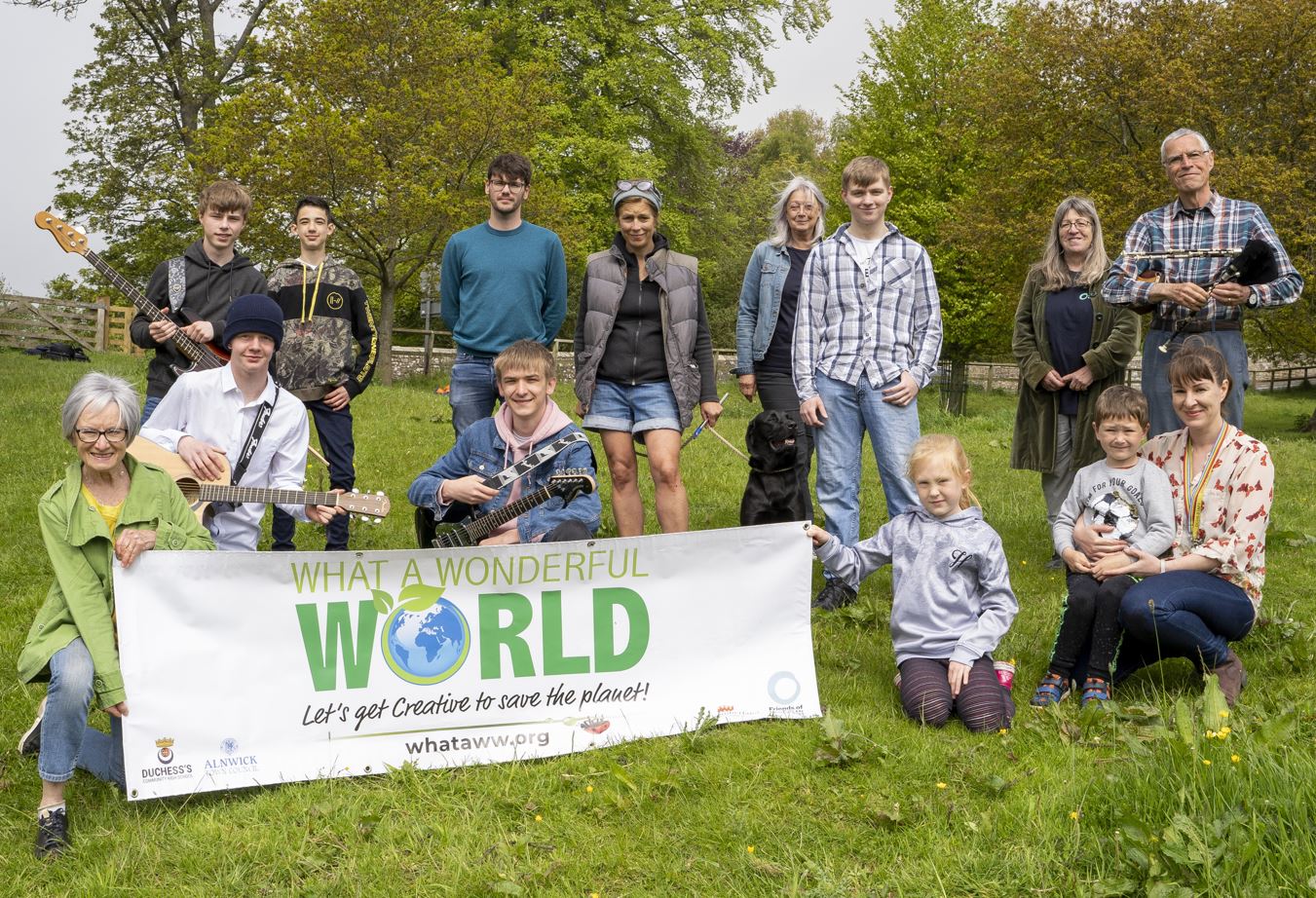
A group of local friends formed a small organising team to put ideas into action. We wanted young people on board as much as possible and, despite the hurdles presented by the pandemic, the staff and students of the Duchess's Community High School were keen to be involved. Glendale Middle School has since joined us. Friends of the Earth Alnwick Area are a key 'pillar' organisation and we have the support of Alnwick Town Council and Northumberland County Council. We launched What a Wonderful World in Alnwick in June 2021 (Gazette Photo: banner and team).
Our first event will be a free Climate Action Day on Saturday 23 October 2021 at Northumberland Hall, Market Place, Alnwick from 10:30 to 17:00.
We open with live music from Glendale Middle School Ceilidh Band followed by four short, sharp, talks on local transport, forestry, green jobs, and energy in the home by local experts, with a Question and Answer session. The focal point of the day will be an interview with local MP Anne-Marie Trevelyan on her role as Energy Minister and Cabinet team member for COP 26, the UN global climate conference in Glasgow due to take place in early November.
Students from the Duchess's Community High School will present 'Top Tips to Save the Planet'. 'Fast fashion' is a big concern as it uses huge quantities of water, and also raises serious issues of low wages and human rights in that industry: the Trash Fashion showcase from local students will provide some imaginative sustainable alternatives.
Stalls by local campaigning organisations including Alnwick Area FoE will provide information and ideas about COP 26 and how we can each reduce our carbon footprint and improve the local environment and natural world. Well-known performer/educator Sandra Kerr will help us round off the day with some thoughtful and inspiring songs so that we leave energised to tackle the challenges ahead.
We hope to learn a lot from this event to help us further develop our planned climate-themed Festival on 24-26 June 2022. The What a Wonderful World Festival will bring together scientists, people in the creative industries, farming, and the natural world. Performances by professional and top local performers will take place at Alnwick Playhouse and the Market Place. A 'Farming for the Future' event is also scheduled and there are plans to bring book lovers together for a session about climate fiction.
We hope the event will attract the interest of a wide range of people in North Northumberland and further afield!
Get creative NOW for a sustainable future!
Posted on 9 September 2021
Co-Organiser and Trustee, What a Wonderful World Trust
Reg Charity Number 1195577
Recycling, Plastics, and Incineration
A point of view from Terry Smith
Our stall at the Alnwick Food Festival in September 2019 focused on plastics, waste, and recycling and provoked many questions from the public. What happens to the 'recycling' when it goes to the depot? Why is there so much unnecessary plastic packaging on products bought in shops? Why do recycling policies vary from area to area? Why is recycling so complicated and why can't there be reuse of many products?
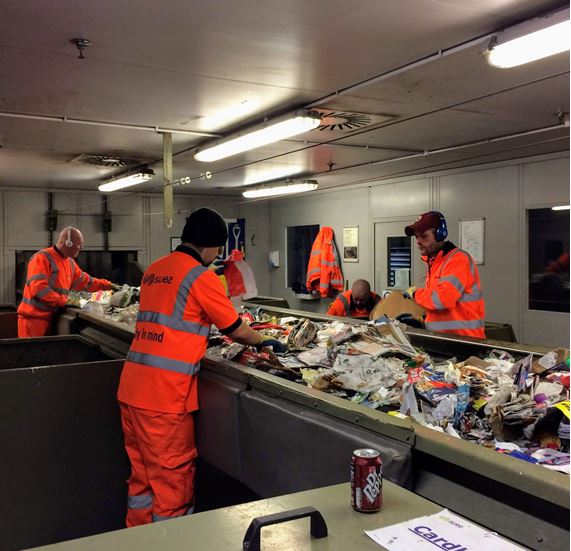
The group set out to find some of the answers to these questions by visiting the Suez recycling and recovery centre in Bedlington in November 2019. In this facility we witnessed impressive and complex machinery but we also saw that a considerable amount of the sorting was done by hand. It was made clear that many policies and requirements on recycling were made by central government and local authorities. We were told that the plastics which had previously been sent to China were now not wanted by that country. Most household waste and some recycling went to Teeside to an incineration plant which produced some electricity from the burning.
Sometime after our visit we heard on the media that a considerable quantity of our UK plastic had been exported to South East Asia and Turkey where much was burnt, in some cases putting the local population at serious risk from the polluting effect of inhaling toxic fumes. It was clear that we were exporting our plastics problem to countries with poor recycling practice. We also became more aware of the devastating effects of plastics ending up in the sea. Perhaps, we wondered, incineration was at least part of the solution to our plastics problem.
Almost certainly this is not the case. As a recent Channel 4's Dispatches programme revealed, burning plastic in incinerators is dirtier than burning coal.* Incineration is seen as a cheap and easy way of getting rid of rubbish but a lot of recycling goes on to be burnt. Dispatches told us that 2% of our electricity is produced from burning rubbish. We now burn more waste than we recycle. It is proving cheaper to incinerate than to recycle or reuse. Of course the amount of power used to produce, to replace, and transport plastic products has to be set against the power produced through incineration.
Often quoted recycling rates are really recycling collection rates. The public generally don't know where their recycling goes and assume that the materials they put in for recycling are recycled or reused in some way. But again from Dispatches, 11% of collected recycling is incinerated whereas an estimated 60% of waste which currently goes for incineration could be properly recycled. We are burning valuable resources.
Dispatches revealed that the increase in burning waste together with the reduction of coal usage has meant that incineration is now a greater source of CO2 than coal. In 2019, 48 incinerators emitted 12.6 million tons of CO2. When coal is phased out incineration will become the dirtiest form of electricity production in the UK.
What we have seen in recent times is a greater emphasis on incineration despite the known negative impacts. Waste incineration plants are still being built. This is controversial for a number of reasons. They are so expensive to build that they require an ever increasing usage in order to help pay back the initial cost. In other words there is less incentive to recycle and reuse and more of a drive to burn. As a group concerned about recycling we fear it is 'back to the drawing board'. Certainly incineration isn't the answer.
Posted on 30 March 2021